

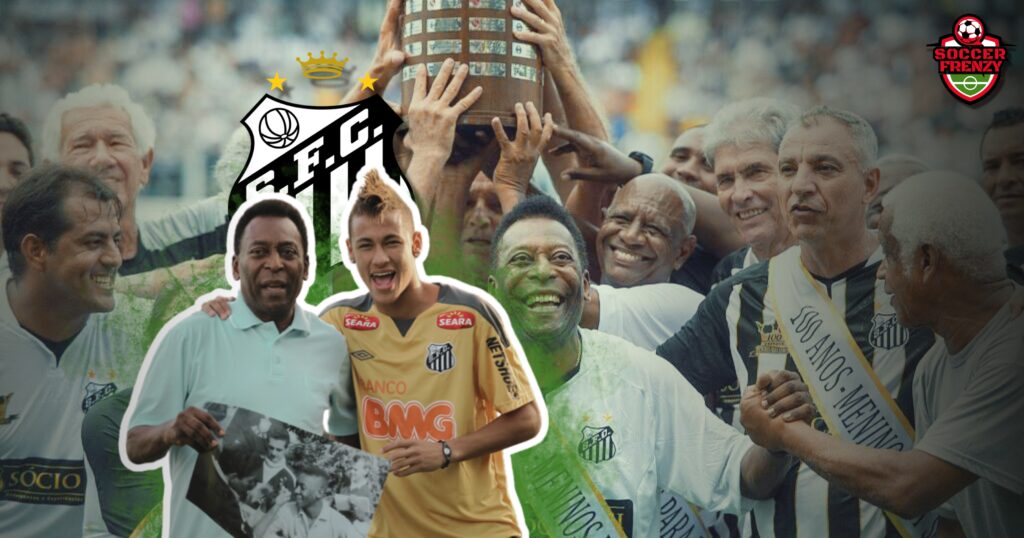
Santos – Let’s delve into the magnificent story of the rise and fall of Brazilian club.
This history is so remarkable that it could easily be the plot of a Hollywood production. Here’s how it unfolds:
The final whistle blows. Shock. Tears. And the crowd’s fury. Everything hurtles toward the field: fireworks, cups, flip-flops, stadium seats, and even a toilet seat. A group of fans rushes onto the pitch, attempting to attack the players, but the police intervene.
Half an hour later, tear gas mingles with smoke from burning cars. Buses and Colombian striker Steven Mendoza’s jeep are engulfed in flames. Staggering grenades explode in the background, accompanied by furious chants: “Shameless team!”
This isn’t an action movie scene or a gangster war. It’s simply Santos experiencing relegation from Brazil’s top division for the first time in its 111-year history.
Santos hails from a modest port city with half a million inhabitants by the country’s standards. Too humble, perhaps, to match the ambitions of one of football’s greatest clubs.
So why is Santos so remarkable? And how did it hit rock bottom? Here’s a hint: it involves a wealthy, eccentric, and ascetic president who still drives an „Opel Zafira”
The Grandeur of Santos: The 1960s with Pelé, Worldwide Tours in Rockstar Style, Bob Marley’s Love, and Over 100,000 Spectators at Matches.
Santos is a classic in world football. It has won the Brazilian championship eight times (only Palmeiras has more with 12 titles). In 2000, Santos ranked fifth on FIFA’s list of the best football clubs of the 20th century—ahead of Barcelona, Juventus, Arsenal, Milan, and Inter.
The love for Santos extended globally, with clubs around the world adopting its name: Santos de Guápiles in Costa Rica, Santos Tartu in Estonia, Santos Laguna in Mexico, and Santos in Guyana. Some of these “Santos offspring” achieved success, like Kingston Santos, who were Jamaican champions four times in the ’70s.
Santos even gets a mention in Olympiacos’ anthem. In 1961, the Greeks defeated Pelé’s squad 2-1 and still take pride in that victory. The second stanza of their anthem ends with the phrase “κι ακόμα σε θυμούνται η Σάντος κι ο Πελέ,” which translates to “Pelé and Santos still remember your name.”
The club boasts numerous celebrity fans.
One of the most famous is Bob Marley. In the ’80s, he visited Brazil for a friendly match with other celebrities, sporting a Santos jersey.
It would be foolish to deny that Santos’ wild popularity owes much to Pelé and the golden team of the ’60s. During that time, no one dominated Brazilian football like Santos. Six domestic championships, two Copa Libertadores titles, and two Intercontinental Cups (making them the world’s best club twice). In 1962, Santos won every tournament they entered.
Before that, Santos was considered a provincial club, founded on April 14, 1912—the same day the Titanic sank.
Until the mid-’50s, they only knew the São Paulo state championship, coming close to the title in 1927 but losing out to Palmeiras by a single point.
Pelé’s debut in 1956 marked a turning point for the great team. In Santos, the King became a three-time world champion with Brazil. But let’s not forget the other stars: Zito, Gilmar, Mauro Ramos, Joel, Lima, Coutinho, Pepe, Carlos Alberto Torres, and Orlando. Players from Santos and Botafogo formed the backbone of Brazil’s national team during the 1962 and 1970 World Cups. In two matches—against Germany and England—eight representatives from Santos played for Brazil.
It’s no surprise that Santos, with its vibrant and thrilling style of play, has garnered a massive fan following. The team has attracted crowds of over 120,000 spectators on several occasions. Notably, during the 1963 Intercontinental Cup match against Milan, Santos set a record with more than 132,000 fans at the Maracanã Stadium.
Santos and Pelé became household names worldwide. From the late ’50s to the ’70s, the team embarked on global tours, visiting five continents: America, Asia, Africa, Europe, and Oceania. Santos played in the USA and Australia, crisscrossed Africa and Europe, and even graced Italy, Spain, England, Germany, Argentina, and many other places. There’s a myth that during a Santos match in Africa in 1969, the Nigerian civil war paused for two days. However, even Pelé himself expressed uncertainty about the accuracy of this claim.
Their schedule was as packed as that of rock stars. Sometimes they played every day, and occasionally, it was multiple matches per day. In 1959, Santos traveled to Europe, playing 22 matches from May 23 to July 5: 13 wins, 5 draws, and only 4 losses. They scored an impressive 77 goals, with Pelé leading the way as the top scorer with 28 goals.
Santos occasionally seemed oblivious to their opponents, defeating mighty Barcelona 5-1 at Camp Nou, playing a thrilling 5-3 match against Real Madrid, and utterly dismantling Inter with a 7-1 victory.
It was a golden era!
However, Santos always faced financial challenges due to their small city and stadium. Their extravagant globetrotting earned them the nickname “wandering minstrels.” But the club entertained people, not from a life of luxury, but for the love of the game—and yes, for money too. Due to their extensive travels, Santos even declined to participate in the Copa Libertadores for several years.
Pelé recalled that Santos earned more than $20 million during their global tour. Quite a substantial sum! For context, consider that in 1961, a record transfer—Luis Suárez from Barcelona to Inter—amounted to £152,000. A new Fiat in the ’60s would cost around $1,500. With three to seven million dollars, one could have built a stadium on par with Camp Nou or Santiago Bernabéu.
It fought for every dollar. During their tour in England, Stoke City promised £12,000, but only if Pelé played. And in the ’70s, Santos made money with Plymouth. Just before the Brazilians’ match, a fixed fee of £2,500 was offered. However, when they saw over 40,000 spectators in the stands 15 minutes before kickoff, they issued an ultimatum: “We want an additional £2,500, or we’ll leave.”
Plymouth realized they had no choice—canceling would have incited the crowd. After the match, the club’s secretary packed £50 notes in cellophane bags, and the furious chairman told someone from Santos, “We’re complaining about you. You’ll never play in this country again.” The response? “Fine. There are still plenty of other countries.”
It faces historical and existential challenges. As the only Brazilian superclub not based in the state capital, it calls Santos—a coastal gateway to São Paulo—home. Getting there takes over an hour by car. The capacity of their home stadium, Vila Belmiro, is around 17,000 spectators. Occasionally, Santos rents arenas in São Paulo, but this isn’t a reliable long-term solution.
Debt, crises, and financial woes have been recurring themes every few years. After Pelé’s departure, it experienced sporadic collapses. The late ’90s and early 2000s were marked by turmoil.
In 2002, it faced financial difficulties, leading them to sell players. However, they were saved by their academy graduates. Not only did they survive, but they also became champions and reached the Copa Libertadores final. In 2009, another crisis emerged—lack of funds—prompting another turn to their academy. Neymar then skyrocketed into orbit.
Ultimately, it was Neymar and competent leadership that saved the club from bankruptcy. When Luis Álvaro Ribeiro became Santos’ president in 2010, the club was in dire straits—selling fewer than 4,000 jerseys, receiving a paltry $4 million annually from sponsorships, and having total annual revenues of just $34 million.
Ribeiro strategically hired top specialists in marketing and law. Three years later, the club secured $19 million from sponsors, and 25,000 new jerseys were sold in just 45 days. Annual revenue exceeded $90 million. In 2013, according to Brand Finance, Santos became Brazil and South America’s second most valuable club and the 38th worldwide.
Leadership changed, talented managers left, and Neymar, who had reignited media interest in Santos, was sold. And so it began again—financial troubles, debts, and liquidation. The crises in 2015 and 2020 due to COVID were particularly painful.
Today, Santos carries a debt of $142 million. The issue isn’t just the debt (because other superclubs like São Paulo and Corinthians have even more). It’s the same old story—modest fan base, a small city, and a humble stadium. In terms of ticket sales revenue, Santos ranks fourth at the end of the 2023 season, with earnings of $2.4 million. The leader in the rankings—Flamengo—raked in $34 million, while São Paulo came second with $22.7 million.
But Santos has a lifeline—their academy. It saved the club during tough times and brought in money.
Despite all the challenges, Santos has a stable income source. And it’s not from globetrotting adventures; it’s their top-tier academy.
The Santos Academy operates as a franchise brand worldwide. With over 90 branches—from Japan to Paraguay, South Korea to the USA—Santos has a wide scouting network and a well-organized team system.
Youth players at Santos enjoy excellent facilities—training grounds, exercise halls, dining areas, and comfortable rooms. The club even has a designated social worker and psychologist. If you want a trial, simply send a video clip of your game on YouTube.
The academy has always supported the men’s team when things weren’t going well. This happened in 2002—a crisis, player sales, and a focus on youth. Several players, including Alex, Robinho, and Diego (the latter two becoming key figures), were promoted to the senior team, filling the gaps with free agents or inexpensive players. The result? A championship.
In 2003, amidst financial woes, Santos invested nothing in transfers. Instead, they turned to academy talents to reduce costs. The plan worked perfectly, and with Robinho and Elano, they clinched the title.
In 2009, against the backdrop of problems, Santos recruited Neymar and Ganso from the academy, forming a powerful team that dominated opponents. By early 2014, Santos had 40 players in their squad, with 26 academy graduates.
It was finished by its eccentric president.
Andres Rueda is 68 years old. He always wears a suit and carries a cane because he suffered from polio as a child. Rueda lives in Santos with his wife, dog, and parrot. His son settled in Australia and opened a pizzeria there.
Rueda loves rock music (Black Sabbath, Led Zeppelin, and Pink Floyd) and the fast life, especially motorcycles, boats, and jets. Another hobby of his is poker: “It helps me read people.”
Andres was born in Spain and discovered Brazil at the age of three – on November 20, 1969. He opened the ABC newspaper and saw Pelé’s thousandth goal on the cover. Since then, he has been captivated by the King and Santos.
After graduating, Rueda spent 20 years on the stock exchange – he was a programmer, analyst, manager, and director. In 2000, he left and founded the technology company Uranet (specializing in customer service).
Andres got involved with the club in 2015. At that time, through a friend, the club’s president contacted him with an unusual request – he urgently needed to transfer $200,000 to Internacional for Lucas Lima. Rueda attended the meeting and as a gesture of gratitude was included in the management committee. In 2017, he ran for president of the club, but came in second.
Before the next elections in 2020, Rueda again lent money to Santos. This time, to pay off the debt to Hamburg for Cléber Reis and avoid FIFA sanctions. Perhaps with this generous step, he bribed the voters.
In Santos, he confronted the system and declared war on agents. The club categorically refused to pay from their side. But he also significantly narrowed the market choice. Rueda also removed the penalties in coaches’ contracts. A controversial decision that led to fewer coaches willing to train Santos.
However, in three years, the club had 10 coaches. Similar chaos occurred in other positions. During the season, Santos lost its sports director. And Rueda began to fulfill his duties until he found a suitable candidate. It didn’t go very well.
Andres made one bad decision after another. Coaches and players changed endlessly.
Rueda was worried and wanted the best, but it didn’t work out for him and Santos. At one point, the president complained about the refereeing, which cost Santos 10 points.
Unfortunately, it all ended sadly.
After his departure, Rueda’s presidential term ended. The new boss is Marcelo Teixeira, who led Santos in the 90s and the Millennium and won the Brazilian championship.
Teixeira imposed a ban on Pelé’s number ten until Santos returns to the elite. When will that happen?
Read more about the latest football news.